Guidance For Council Tax Liability Students
Revenues D Blades / Mar 2014 |
|

Guidance For Council Tax Liability Students
Revenues D Blades / Mar 2014 |
|
A reduction in liability for council tax can be applied where one or more occupants are students and meet the qualifying criteria.
The basic council tax bill for any dwelling is made up of a 50% property charge and a 50% charge for adult residents on the assumption that there are 2 adults living in the property.
Where the property is solely occupied by students then a full exemption from council tax is awarded.
Where the property has more than one occupant who is not a student, then those who are students under the qualifying criteria will be disregarded from council tax. Where only one occupant remains liable for council tax then a disregard discount is awarded.
Where the property was the occupants sole or main residence and they were a full time student, or became a full time student within 6 weeks of leaving the property, provided the property remains unoccupied they will be entitled to an exemption (Class K) for the period of their full time study or tenancy (whichever ceases soonest).
Where a property is owned by a student but is not their sole or main residence (ie: where they were / are the landlord), then liability for council tax remains theirs. No reduction on the grounds of being a student will be applicable. Any furnished / unfurnished reductions will apply.
Each year the Class N student exemption should be ended and re-added the next day – no gap in exemption but clear that awarded on a year by year basis.
Example: review form received where exemption currently has a review date 30-SEP-2011, the end date will be updated to 30-SEP-2011, next exemption start date 01-OCT-2011 with a review date 30-SEP-2012)
In order to qualify for a reduction on the grounds of student status, for council tax purposes one of the following criteria must be applicable:
2.1 Students
A student means a person who is:
A Foreign Language Assistant registered with the Central Bureau for Educational Visits and Exchanges; or
Undertaking a ‘qualifying course of education’ (See definition below); or
Undertaking a ‘full time course of education’ (See definition below).
2.2 Student Nurses
Student nurses studying academic courses at Universities or Polytechnics, who are undertaking a course which would lead to registration under the Nurses, Midwives and Health Visitor Act, will be considered as students for Council Tax purposes.
A student nurse on a course leading to registration on any parts on 1 to 6, 8, 10 or 11 of the Nursing Register will be disregarded.
Nurses who are already on the Register but are taking further courses will not be disregarded.
2.3 Qualifying Courses of Education
A person is to be regarded as undertaking a qualifying course of education on a particular day if on that day:
He or she is under the age of 20;
He or she is not undertaking a course of full time education, and
The relevant number of hours per week for that course, or where he or she is undertaking 2 or more qualifying courses with the same establishment, the aggregate of the relevant number of hours per week, exceeds 12.
A qualifying course of education means a course:
Which subsists for more than 3 calendar months
Which is not a course of higher education (see definition below)
With respect to which tuition is principally received otherwise than through correspondence
Which is not undertaken in consequence of an office or employment held by the person in question, and
With respect to which the relevant activities are (insofar as they are normally carried out under the courses at particular times) normally so carried out principally between 08:00am and 05:30pm.
2.4 Higher Education
Courses of Higher Education include:
Courses for the further training of teachers or youth and community workers;
Post-graduate courses (including higher degree courses);
First degree courses;
Courses for the Diploma of Higher Education;
Courses for the Higher National Diploma or Higher National Certificate of the Business and Technical Education Council; or the Diploma in Management Studies;
Courses for the Certificate in Education;
Courses in preparation for a professional examination at higher level;
Courses providing education at a higher level (whether or not in preparation for an examination).
2.5 Full Time Courses of Education
A person is to be regarded as undertaking a full time course of education on a particular day if:
On the day he or she is enrolled for the purpose of undertaking such a course, with a prescribed educational establishment, and
The day falls within the relevant period for that course.
A full time course of education is one:
(i) Which subsists for at least on academic year of the educational
establishment concerned or, in the case of an educational establishment
which does not have academic years, for at least one calendar year.
(ii) Which persons undertaking it are normally required by the educational
estblishment concerned to undertake (whether at premises of the establishment or otherwise) for periods of at least 24 weeks in academic or calendar year (as the case may be) during which it subsists;
The nature of which is such that a person undertaking it would normally
require to undertake periods of study, tuition or work experience which
together amount in each such academic or calendar year to an average
of at least 21 hours a week during the periods of undertaking mentioned in
paragraph (ii) above in the year;
A course is not to be classified as full time, if the periods of work
experience exceeds the periods of tution or study for the duration of the
course.
3.1 Northumbria and Newcastle University Students
Where the educational establishment attended is Northumbria or Newcastle University, the Council currently have a service level agreement in place to obtain specific details in order to allow verification of student status for council tax purposes. The details provided holds information on all full time students registered for the current academic year.
The information is provided in the format of a spreadsheet and will be provided twice each academic year – October and March.
The file is held in the following location to be accessed for verification purposes:
\\Dfsccs001v\DFSRoot\City Service\Shared\Council Tax Verification Information\Revenues Verification Information
When awarding a student exemption / disregard discount where the occupants have indicated they are studying at Newcastle or Northumbria University, the information can be verified by checking the data supplied directly to the Council by the University.
To check the list the following action should be taken:-
Open the excel spreadsheet for the University attended;
From the toolbar select Edit;
Select Find and enter the student details
If they are a full time student at the University they will then be located on the list
When using the list, please note and adhere to the following:-
The list should be used for verification purposes for the awarding of a reduction on the grounds of being a student only
Only once the information is verified should the exemption / disregard discount be awarded.
If they have stated they are a full time student and do not appear on the list, they may have registered late or they were able to 'opt out' of being included in this information agreement, so they may not show on the data provided. In such cases, they should be asked to provide an appropriate certificate obtained from the University. A bill suppression should be added to the account for a period of 42 days to allow sufficient time for the evidence to be obtained and provided to the Council.
3.2 All Other Educational Establishments
Any educational establishment that provides details of students to the Council will be held in the location detailed above. However, where this information is not provided then a relevant student certificate must be obtained as evidence to award a reduction on the grounds of being a student.
Contact should be made with the student to request they obtain a certificate from their place of education. Where possible, contact should be initially made by telephone or email. If contact in this manner is not possible then the letter should be issued from COMINO titled ‘Student Evidence Required’.
A bill suppression should be added to the account for a period of 42 days to allow sufficient time for the evidence to be obtained and provided to the Council.
In order to ensure the relevant exemption / disregard discount is awarded, it is necessary to establish the liability for council tax. Ensuring the correct liable party details are obtained will allow the prompt and accurate issue of council tax bills.
4.1 All Occupants in Property Entitled To Reduction (Exemption)
Once the student status has been verified (see 3), where the property is occupied solely by students (as defined in the criteria detailed in 2) then an exemption from council tax should be awarded.
The following steps should be followed:-
The account Recovery Profile should be updated to STUDENT (see 5.1)
All tenants should be named as liable parties.
The Responsible Party details should be confirmed and added where not already present (see 5.2)
The number of Occupants must be updated to match the number of liable parties (see 5.2)
Confirmation of the course attended, the Educational Establishment and Student Reference Number must be obtained and detailed on the person status (see 5.3). Where available, the course name, start and end date should also be noted.
Where the tenancy has been taken for the purpose of attending the educational establishment, the Class N exemption should be awarded from the start of tenancy date. Where current occupants have a change in circumstances and become students, the Class N exemption should be awarded from the course start date when all occupants meet the student criteria.
Where the previous tenancy and future tenancy are both entitled to a Class N exemption and there is less than a 6 week gap between the tenancies (after following point 6 above) the previous tenancy and exemption should end the day before the new tenancy and exemption, resulting in no requirement for an additional account for the owner of the property between the 2 student tenancies.
An exemption review date for the 30th September the following year should be added. (If confirmation is received that the course end dates for all student occupiers is within 12 weeks, then the course end date should be added and the review date should be added as the same date).
Details should be added to the account notepad that exemption has been awarded, or student certificates have been requested as evidence.
 Where a Class N is awarded and the property previously had only 1 occupant who was in receipt of a single person discount, at the time the exemption ceases unless information has been received that there are additional occupants the single person discount should be re-applied. The evidence supplied for the original award is still applicable. Any change will be identified within the discount review process.
4.2 Where One or More Occupants Are Not Students (Disregard Discount)
Once the student status has been verified (see 3), where one or more of the occupants are students (as defined in the criteria see 2) then they should be disregarded for council tax purposes.
The following steps should be followed:-
The account Recovery Profile should remain on DEFAULT
The tenant(s) whom is/are not students should be named as liable parties.
The Responsible Party details should be confirmed and added where not already present (see 5.2)
The number of Occupants must be updated to match the number of occupants (including the number disregarded)
Confirmation of the course attended, the start date, the Educational Establishment and Student Reference Number must be obtained and detailed on the person status (see 5.3). Where available, the course name and end date should also be noted.
The disregard should be awarded from each individual course start date.
A disregard review date for the 30th September the following year should be added. (If confirmation is received that the course end date is within 12 weeks, then the course end date should be added and the review date should be added as the same date).
Details should be added to the account notepad that disregard has been awarded, or student certificates have been requested as evidence.
4.3 Halls of Residence and Student Lets (By Agreement with Educational Establishment)
A Class M Exemption is awarded where the property in question is classified as a Halls of Residence. The property may be occupied or unoccupied. The halls of residence must be provided predominantly for students and be owned or managed by an educational establishment or by a charity.
The reason for a separate exemption code is to avoid unnecessary bills being issued and reviews taken place. The Council has an agreement that such properties will remain in the name of the Owner; Managing Agent or University and will be let solely to students. Details of such accounts are provided by the Educational Establishment direct to the Council. Details are also provided when there is no longer an agreement in place to ensure the Councils records are updated accordingly.
5.1 Updating Recovery Profile
The correct recovery profile should be added to the account (see point 4).
The profile can be viewed via the Accounts, Recovery, Recovery Profile Tab:-

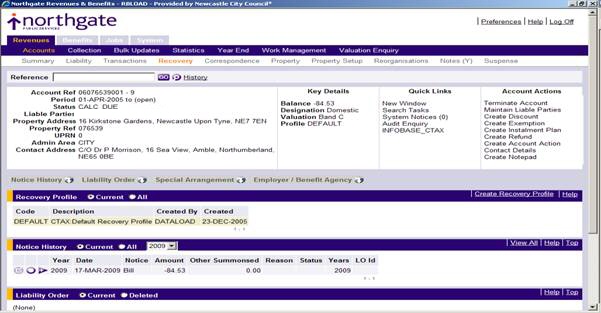
By selecting Create Recovery Profile, the current profile can be amended by selecting the required profile from the drop down menu (ie: STUDENT)
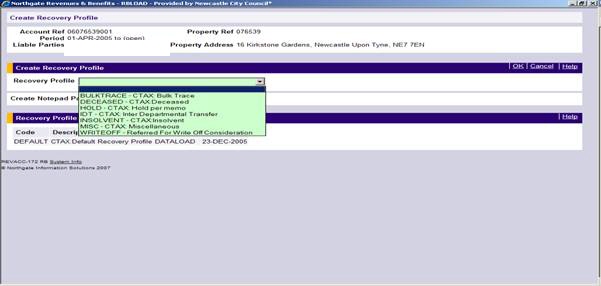
Select OK, and the profile will be updated. By viewing all, the history of profiles on the account will be displayed.
|
|
|
|
5.2 Responsible Parties / Number of Occupants
Responsible Party
Where the occupants of the property are not the owners, the responsible party details must be added.
In all cases, the Owner details must be present
Where it applies, the Managing / Letting Agent details must be present
Where both the above apply then there will be 2 Responsible Parties shown with no End Date. Where new details are provided, the previous responsible party of the same nature should be updated with an end date before the new party details are added.
To Add / Update a Responsible Party, from the Liability area; Responsible Parties select Create Responsible Party (or select Maintain Liable Parties from the account information bar):


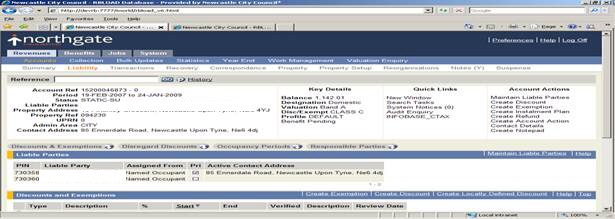


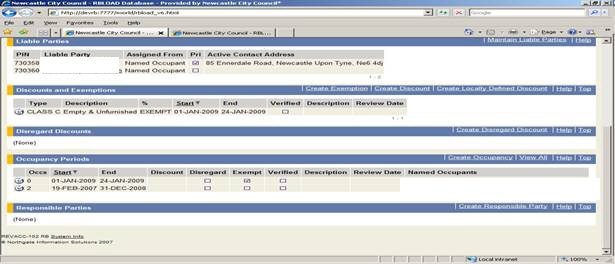
By selecting the Magnifying Glass for the PIN field as search for the responsible party to be added should be carried out. Where they are a known responsible party with several properties in Newcastle, the CTax Common Responsible Party Register should be checked for the correct PIN reference. It is located in the following folder:-
\\Dfsccs001v\DFSRoot\City Service\Shared\Council Tax Verification Information
Where the details are not currently on the system, a new party should be created. Once selected or created, the details will appear.
From the drop down menu for the Responsibility Type, the relevant statement should be selected:
HA – Housing Association HMO – House in Multiple Occupation
L/Holder – Lease Holder Landlord – Landlord Details
Licencee – Licencee Details MA – Managing Agent
Occupier – Owner Occupier Tenant – Tenant (Sub-Let)
The start date must be added. This date is the date we are aware they became the owner or managing agent for the property. Where new details are provided, the previous responsible party of the same nature should be updated with an end date before the new party details are added.
Only where the responsible party is also the liable party should the tick be placed in Make Liable and Primary. Otherwise, these boxes should remain blank.

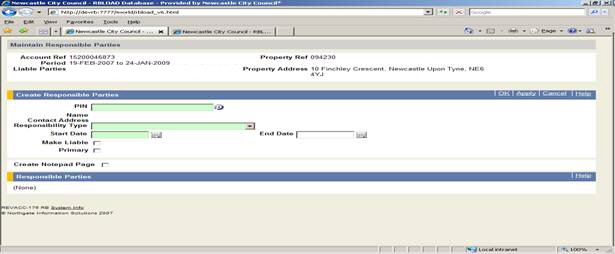
Once all the details have been added, select OK. The details then appear within the liability area.

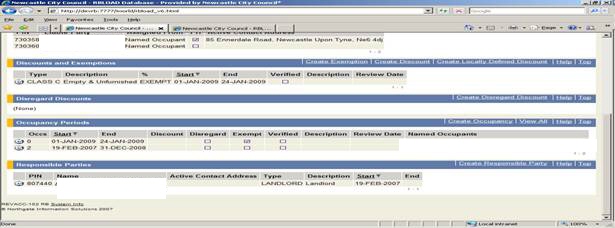
Number of Occupants
The number of occupants must be updated to show all those included for council tax liability purposes.
Where the number of occupants is equal to the number of liable parties the details will be updated automatically from the creation of the liability.
Where a disregard discount is to be applied, then the disregarded person will not be the liable party. This may not be the case where they have the higher interest in the property as determined by the hierarchy of liability (ie: the owner occupier is the student who has a lodger who works full time, the student will remain liable with the disregard discount being applied).
The number of occupants will therefore need amending to ensure all those included for council tax liability purposes are detailed.
Example: 5 occupants in the property where 1 adult is in full time employment and therefore the liable party, the other 4 occupants are students. The Occupancy periods requires updating to 5 in order to update the person status for the students to allow them to be disregarded and the correct council tax liability to be charged.
To update the Occupancy Periods, from the Liability area; Occupancy Periods select Create Occupancy:



Within the Create Occupancy Period amend the Number of Occupants, input the start date for this occupancy period (and end date if amending a backdated change). No other information is required.
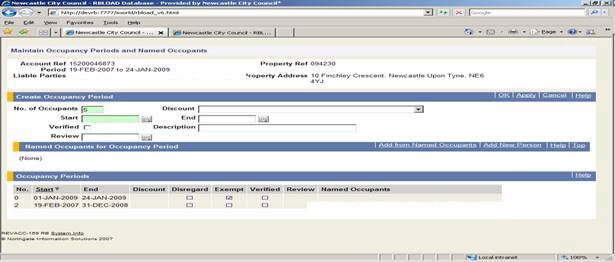
Within Named Occupants for Occupancy Period select either Add from Named Occupants (if occupant already exists on account) or Add New Person. Follow the process through to search or create the relevant person.
Select from the drop down menu if they are to be Liable or the Primary Responsible Party – Unless they are the owner as mentioned previously then the answer should be NO to both.

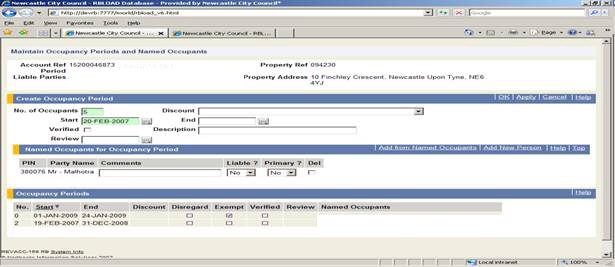
Select OK and the updated details will appear in the Occupancy Periods.
5.3 Updating Person Status Details
Checks should be carried out to ensure that where the person already exists on the system the same Personal Identification Number (PIN) is used. Previous addresses; linked accounts etc… should all be checked thoroughly.
The personal status must be updated with the following student details:-
Course Start Date
Course End Date – but not within the end date field if more than 12 weeks in advance for Class N exemption, or 1 year in advance for disregard (to be added after the disregard has been applied for the person the disregard discount is awarded against – only 1 occupant where more than 1is disregarded)
Student Reference Number
Educational Establishment *
Any additional information provided where there is not sufficient space to include in the personal status should be added to the personal notepad. Such information includes:-
Course Name
Previous Address
Contact Details
It is not necessary to add the full details to the notepad, just to indicate on the notepad that the information has been provided and the location of where it has been saved (ie: the COMINO account reference).
* Due to the space available, the following abbreviations may be used:-
Northumbria University NTHBRIA U
Newcastle University NWCL U
Durham University DRHM U
Gateshead College GTSD C
Newcastle College NWCL C
To update the personal status, select the Liability area and select the relevant liable party:

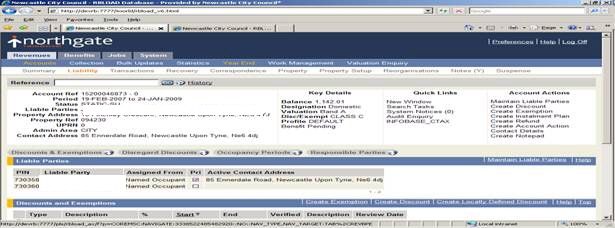
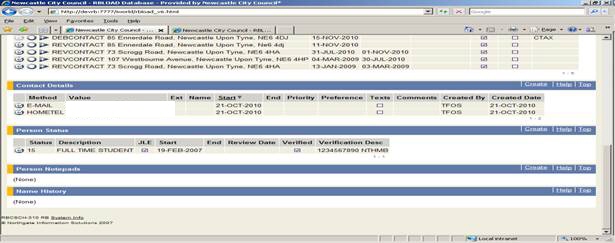
The details for the person will appear. From the Person Status boar select Create:
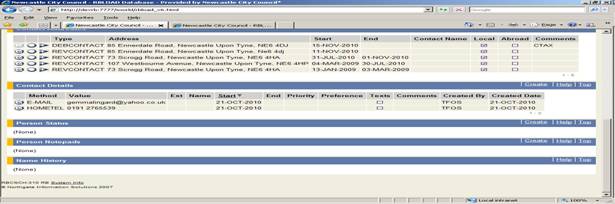
From the drop down menu select ‘Full time Student’.
Within the fields ‘Start Date’ and ‘End Date’ enter the course start and end date (if applicable).. Once added place a tick in the Verified box and add the student reference number and Educational Establishment in the Verification Field. No review date is required.

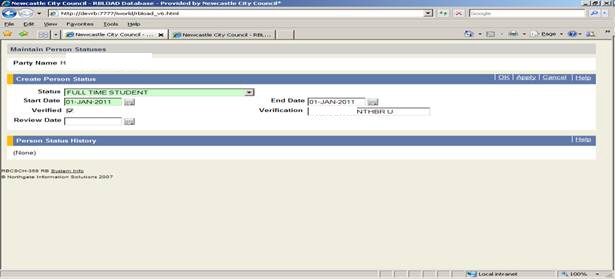
Select OK and the person status details will be updated:
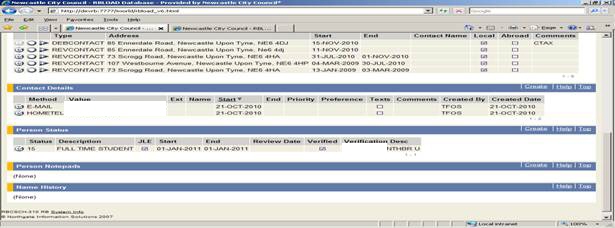
Within the Occupancy Periods area, the student name will now show with <d> after it, indicating student details exist and are current for that person:

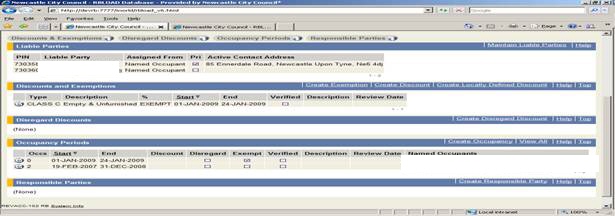
This process should be repeated for each student who appears as a named occupant.
To update the person notepad with any additional information the above should be followed to select the relevant party and within the Person Notepads area select Create:
The notepad entry should then be made in the same format as account notepad entries. Once all required details are added, select OK and the notepad entry is saved for that person.
Awarding A Student Exemption – Class K; M and N
Go to the Liability tab, Discounts and Exemptions and select Create Exemption:

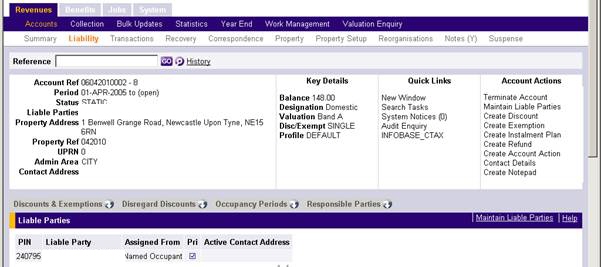

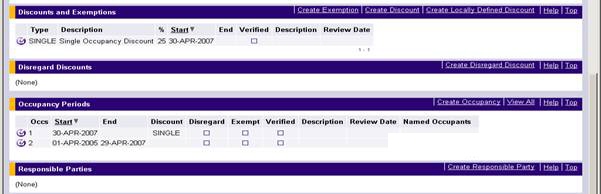
Enter the start date for the exemption and from the drop down menu select the relevant exemption (ie: Class K; M or N).
Enter the end date (if within 12 weeks) and the Review Date (same as end date or 30th September of the following year) – see point 4.
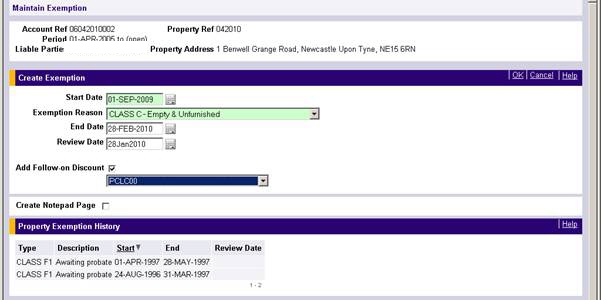
Select OK. The exemption has now been applied to the account.
Awarding A Student Disregard Discount
Go to the Liability tab, Disregard Discounts, and select Create Disregard Discount:


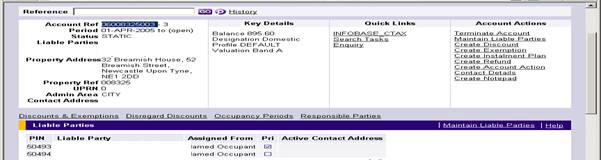


From the drop down menu’s select the person who the discount disregard relates to (or one of them if more than one- to identify which one to use refer to 7.10) and the person status type:
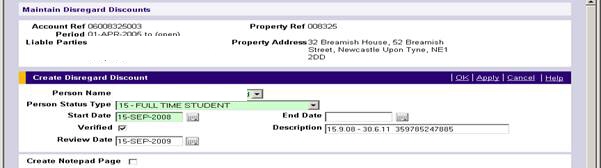
Enter the start date for the disregard discount and the relevant end date (if within 12 weeks) and review date (same as end date or 30th September of the following year) – see point 4,
Please note: the start date for the student person status must not preceed the start date of the account. If this is the case, the person status must be updated to show the same start date as the account.
Place a tick in the verified box and enter the relevant details – see point 4.
Select OK. The disregarded person now has <d> at the end of their name signifying that they are disregarded.

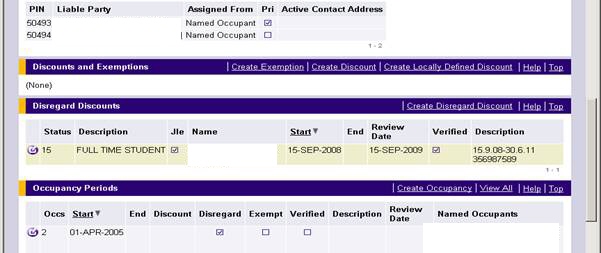
The student status for the selected person must then be updated with the course end date.
6.1 Checks carried out for Student Liability
For the purposes of quality assurance, the following points will be concentrated on from within this guidance:
Students qualifying criteria which is 2.1 - 2.5
Evidence we have received checked and actioned 3.1 - 3.2
All students household 4.1Points 1 to 8
Student and none student household 4.2 Points 1 – 8
Updating person status details
In addition where previous addresses are provided or known existing
Pins should be used and previous addresses updated.
These checks maybe revised in line with any amendments to the procedures.
Backdated Student Liability / Reductions – Creation of New Accounts
Where details are provided that an account for a period in the past needs to be created and the relevant student exemption / disregard discount is required, the liability should be established (see 4) then the depending on the scenario, the most appropriate action taken.
Scenario A *:
Where current contact details for the student(s) are known, they should be contacted to provide relevant certificates from the educational establishment.
Any production of a bill should be suppressed for 42 days to allow sufficient time for the submission of the requested information.
Once information received the relevant exemption / disregard discount should be applied. If the information is not supplied then action should commence to recover any outstanding council tax.
Scenario B *:
Where current contact details for the student(s) are unknown, provided we have been given supporting evidence that is deemed sufficient (ie: Confirmation from landlord / managing agent, student reference numbers, property consistently occupied by students etc…) then the relevant exemption / disregard discount can be awarded.
The contact details should be updated to show the billing address as no forwarding address and the production of a bill should be suppressed to 31-MAR-3000 to avoid the production of an unnecessary bill.
* Where the period of liability in question relates to the 2010-11 academic year or after then the details provided from Northumbria University should be checked to verify student status. It must not be used to verify residency.
In all cases
If the liability is to be created for a period over 3 years in the past then a Senior Revenues Officer should be consulted to establish the best course of action and consideration will be made to the implications on the existing accounts of any liability amendments.
Where the information received falls outside the scenarios detailed, the advice of a Senior Revenues Officer should be sought to determine the best course of action.
Backdated Student Liability / Reductions – Existing Accounts
Where details that a reduction for a period in the past (and in some cases ongoing) is required, the liability should be established (see 4) then depending on the scenario, the most appropriate action taken.
Possible Scenarios
Recovery Pre-Summons
a) 4 people registered and have advised they are all full time students. Change profile to STUDENT and await confirmation of student status. The profile will prevent the normal recovery notices going out. Once the information is received the exemption can be applied to the account.
b) 4 people registered, 3 are full time students and one is working. Suppress the summons for 28 days await confirmation of the 3 full time students. Once this information is received disregard the 3 students and a bill will be issued to the remaining working occupant. Further recovery notices will then only be issued to the working occupant. If the information comes in one by one please disregard each person as you receive the details and suppress the issue of the revised bill for the remainder of the 28 days.
Recovery At Summons Stage
Where a summons has been issued and details are received that an exemption / disregard is required that will reduce the liability then the summons should be withdrawn back to reminder and the liability amendments carried out. Where all occupants are students the recovery profile should be updated to STUDENT.
Recovery Post Liability Order
a) 4 people registered and have advised they are all full time students. Change the profile to STUDENT and await confirmation of student status. Once the information is received the exemption will be applied to the account. The liability order and any costs incurred should remain on the account and the relevant recovery action will be taken.
b) 4 people registered, 3 are full time students and one is working. Any ongoing recovery action will continue until evidence is received. However, if bailiff action has commenced the Recovery Team should be notified to request a hold on the bailiff action for a period of 28 days to allow the return of information and the account to be amended. Once this information is received disregard the 3 students and a bill will be issued to the remaining working occupant. Further recovery action will only be taken against the working occupant as the liable party. If the information comes in one by one please disregard each person as you receive the details however please suppress the bill for a maximum of 28 days until we have all the information.
In all cases
Where the required information to award a reduction is received after the issue of a court summons but prior to the court hearing, the summons will no longer be valid and therefore must be withdrawn, If this is not updated, then the exempt / disregarded party/s progresses through the court process incorrectly.
Where the required information is received after the court hearing then the costs have been incurred correctly and are recoverable from the liable party/s. In the case of a Class N award, all liable parties will be issued with recovery correspondence as they are joint and severally liable for any outstanding costs. In the case of a disregard discount award, the recovery correspondence will be issued to the remaining liable party but if the costs are unpaid and action proceeds, when dealing with an enquiry this should be taken into account.
Such instances should only occur where the Council were not previously aware that all occupants were students as in these circumstances the correct recovery profile will have been used (STUDENT) ensuring that the correct recovery route is followed.
Where the information received falls outside the scenarios detailed, the advice of a Senior Revenues Officer should be sought to determine the best course of action.
Future Student Reductions Verification – Newcastle and Northumbria University
The information to verify student status for Council Tax purposes will be provided by Newcastle and Northumbria University twice each academic year (see Point 3).
In some cases the details to update or create council tax accounts will be received from Newcastle and Northumbria students prior to the receipt of the information. In order to ensure the Councils records are maintained efficiently, the relevant exemption or disregard discount should be awarded on receipt of the information.
Once the details are received from the University, those accounts that have had a recent student exemption / disregard award prior to its receipt will be verified.
Those which are not verified by the details supplied will be contacted to provide the relevant exemption certificate. Where the certificate is not provided, then the exemption / disregard discount will be removed.
All accounts created for other educational establishment should not have the exemption / disregard discount awarded without a relevant certificate being provided (see Point 3.2).
Each year the exemption should be ended and re-added the next day – no gap in exemption but clear that awarded on a year by year basis. Will be done from returned reviews or contact direct from tenants / occupiers.
Foreign Students – Pre-Course Entry Courses of Education
In cases where foreign students attend a pre-entry course, these courses are usually for a period of 12 weeks.
Attendance on such courses does not constitute full time education for student exemption / disregard discount purposes. Council tax should be demanded as normal.
If however, the student then progresses on to a course of full time education then any applicable exemption / disregard discount awarded will be backdated to the start date of the pre-course entry course.
Students With Occupants Whom Have No Recourse To Public Funds
Where any additional people are resident with a student but have no legal status in this Country, and / or are unable to work or have no recourse to public funds (ie: are unable to claim any state benefits), then they should not be included in any liability for council tax, and not detailed as a named occupant.
Evidence of this must be obtained (copy of passport or legal document), and full details of the additional people should be entered on the account notepad for reference purposes.
The relevant student exemption / disregard should be awarded. If the circumstances change and the status of the additional person renders them available to work or claim state benefits, then they will be included in any liability for council tax, added as a named occupant, and the correct entitlement to a reduction would need to be established (see point 4).
No Evidence Supplied – Follow-up Action for Exempt Accounts
Where the Council are aware all occupants are students but evidence has not been received from each occupant, follow up action will need to be taken to ensure evidence is obtained or recovery notices are issued.
These accounts will all be set to the recovery profile STUDENT to allow the appropriate progression to take place.
On a monthly basis a report will be issued for all accounts with the recovery profile STUDENT where a balance remains due. Attempts will be made to contact the student(s) to obtain the appropriate evidence.
Dependant on the resources available and the number of accounts present on the report will determine the best course of action.
Action will include the following:-
Telephone Contact
Email Contact
Reminder Correspondence
Accounts where correspondence is issued and information is still not received will then be updated to recovery profile DEFAULT and progress through the recovery process which could result in the issue of a court summons. If this is the case, any exemption / disregard discount will not be awarded until after the court hearing date and any costs incurred will require paying to avoid enforcement action being taken.
The Council will ensure that all possible action is taken to obtain all information in order to award the exemption and avoid unnecessary court action.
Bill Supressions – Checks Carried Out
Where a bill suppression exists, checks will be carried out by the Revenues Housekeeping Team to ensure that the correct suppressions are in place for student accounts.
The following suppressions should be used / checked:-
31-MAR-3000 – to be used where account is closed and has a NIL balance
Open ended (ie: no date) – to be used where account has a balance due but no forwarding address known
Within 42 days of date of report – to be used when allowing time for evidence to be supplied.
Review – Process To Review Student Liabilities
All accounts where a reduction is in place on the grounds of student status will be reviewed on a yearly basis.
The review process is carried out using the review dates so it is essential that the correct review dates are added.
The review will be carried out in as detailed in ‘Council Tax Review Guidance - Students’.
Verifying Educational Establishments
Where there is any uncertainty with the validity of the evidence supplied or the educational establishment, they should be contacted direct. In all cases, the advice of a Senior Revenues Officer should be sought prior to any contact being made.
Where you feel there may be some suspicion that evidence is fraudulent, then the educational establishment should be validated by checking one of the following:
https://www.gov.uk/government/publications/register-of-licensed-sponsors-workers
http://www.education.gov.uk/edubase/home.xhtml
7.10 Identifying Which Occupant to Use for Discount Disregard Award
In order to ensure the correct level of reduction is applied to the account, once the person status has been updated for all student occupants then the appropriate person should be selected for the Discount Disregard to be awarded against.
1 occupant who is a qualifying student
No discount disregard required, Class N exemption should be awarded
2 or more occupants where all are qualifying students
No discount disregard required, Class N exemption should be awarded
2 occupants only 1 of which is a qualifying student
The discount disregard should be awarded against the qualifying student
More than 2 occupants, where 2 (or more) are not qualifying students
Person status for qualifying student to be updated but no discount disregard to be awarded
More than 2 occupants, where all but 1 are qualifying students
Person status for all qualifying students to be updated and the discount disregard to be awarded against the student who has the earliest course end date.
(Using the review process, when the account is updated from information received from the review, the occupant to be disregarded will be confirmed using the same criteria so in some cases the occupant may change, dependant on course durations).
7.11 Updating Student Liabilities – June to September
Where a student change in circumstances is received for the forthcoming academic year it may not be possible to verify the student status at the time the information is received as the university lists used for verification will not be received until October and exemption certificates may not be supplied until after the academic year commences.
Where a Class N exemption will be applicable, the Recovery Profile for the account should be STUDENT.
University of Newcastle and University of Northumbria Students
Where all occupants are full time students of the University of Newcastle or Northumbria, the liability should be updated and the disregard or exemption awarded. The appropriate end date / review date should be added dependant on length of course (refer to Council Tax Student Liability Guidance).
The attendance will be verified by carrying out the student review (as detailed above) and where verification is not possible, the disregard or exemption will be removed, a notepad entry will be added to explain the reason for removal and a revised bill issued.
Where a Class N exemption has been removed as verification has not been possible, the recovery profile will remain on STUDENT to follow up after a 4 week period, and where no further contact has been made to verify status the profile will be updated to DEFAULT and the account will progress through the ordinary recovery process if applicable.
Accounts with the recovery profile STUDENT where a balance remains due as the exemption has not been awarded are periodically checked by Revenues Housekeeping.
Other Educational Establishments
Attendance will require verifying by receipt of an exemption certificate from the educational establishment (or confirmation from the educational establishment if verification information is received).
The liability should be created following the instructions set out within the Student Liability Guidance. However, the bill suppression should be added to prevent a bill being issued until after the 31st October.
The account will be checked by Revenues Housekeeping using the STUDENT recovery profile follow up report and certificates requested. For those not received and updated by 31st October, the initial bill will be issued (refer to Revenues Reports – Student Follow up Guidance).
Once the student verification list(s) are received, the liability should be updated and verified at the time the process is carried out.
Letter Templates
Definitions from Exemption desk aid for Class K; N & M